In 30 Seconds
- During his visit to the Philippines capital, the Prime Minister gave world leaders handmade works from across India, each tied to a distinct regional tradition.
- US President Donald Trump received a golden Pichwai painting from Nathdwara in Rajasthan.
- Japanese Prime Minister Sanae Takaichi was given a royal blue Banarasi Katan silk stole in a Sadheli box.
Prime Minister Narendra Modi presented a range of traditional Indian handicrafts to foreign leaders during his visit to Manila, using the exchange to highlight regional artisanship from Rajasthan, Kashmir, Uttar Pradesh, Karnataka and Tamil Nadu, according to officials.
US President Donald Trump received a golden Pichwai painting from Nathdwara in Rajasthan. The cloth-painting tradition is known for fine detailing and luminous colour. Officials said the work uses mineral pigments and gold on prepared cloth, with motifs such as lotuses, cows, trees and ornamental borders.
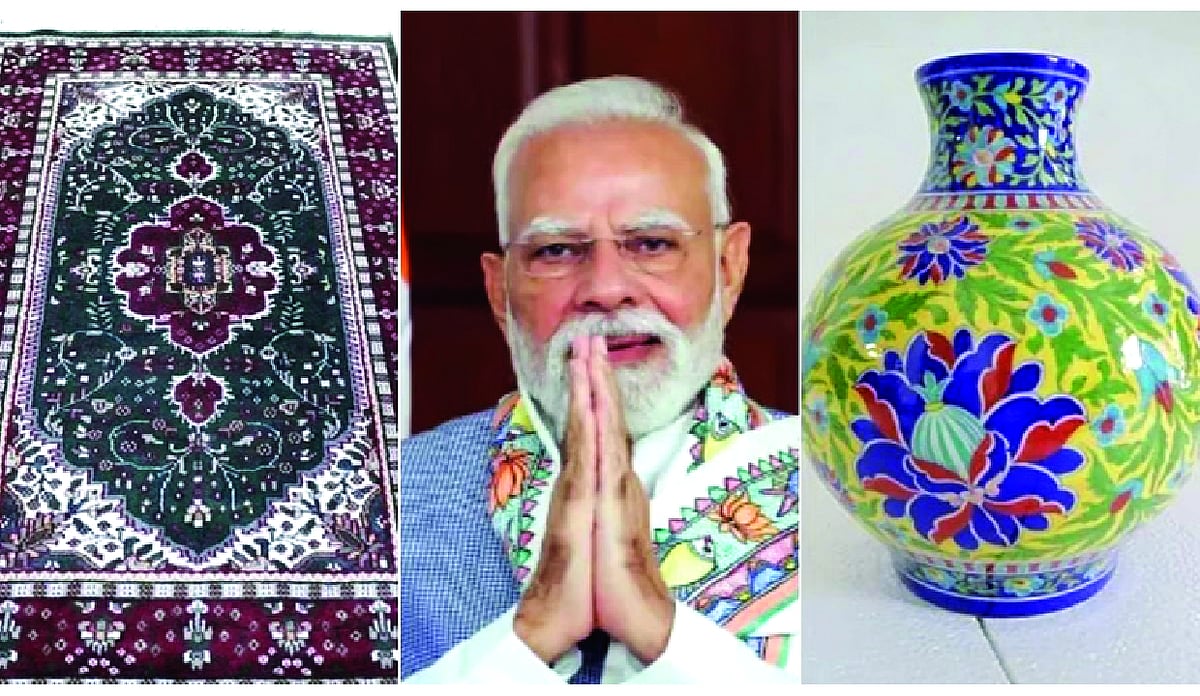
Japanese Prime Minister Sanae Takaichi was given a royal blue Banarasi Katan silk stole in a Sadheli box. Australian Prime Minister Anthony Albanese received a blue Jaipur pottery piece, a craft made from a quartz-based mixture instead of ordinary clay, which gives it a translucent finish and hand-painted cobalt designs.
The host, Philippine President Ferdinand Marcos Jr., received a hand-knotted Kashmiri silk carpet, a craft in which thousands of knots are tied by hand and larger pieces can take months or years. His spouse was given a Pashmina shawl in a papier-mache box, pairing two Kashmiri crafts: fine cashmere fibre from the Changthangi goat, and a hand-painted paper-pulp container.
Other gifts leaned on metalwork and stone. Brunei's Sultan Hassanal Bolkiah received a Bidriware vase from Bidar in Karnataka, made of a zinc-and-copper alloy with silver inlay. Indonesian President Prabowo Subianto was given a Chola bronze sculpture, made by the lost-wax method known as Madhuchista Vidhana, in a tradition dating from the ninth to thirteenth centuries. Laos's Saleumxay Kommasith received a hand-decorated rose quartz elephant, a craft associated with Jaipur's stone-carving centres.
Such gifts matter beyond protocol. Choosing objects tied to specific regions and techniques lets India present its craft heritage as part of its diplomatic identity, and draws attention to artisan communities whose skills are often passed down through generations. The selection also appeared matched to each recipient, favouring textiles, metal and stone pieces with symbolic meaning.