In 30 Seconds
- The president's intervention returned Huang to the helm 11 days after his removal over a Chinese espionage scandal, drawing bipartisan calls for scrutiny.
- US President Donald Trump intervened to restore Jensen Huang as chief executive of Nvidia on Monday, eleven days after the chipmaker's board pushed him out amid a scandal involving alleged Chinese espionage.
- Trump defended the decision in a CNBC interview on Monday, saying he had watched markets lose trillions of dollars in recent days, with the Huang affair a contributing factor, and that he felt compelled to act.
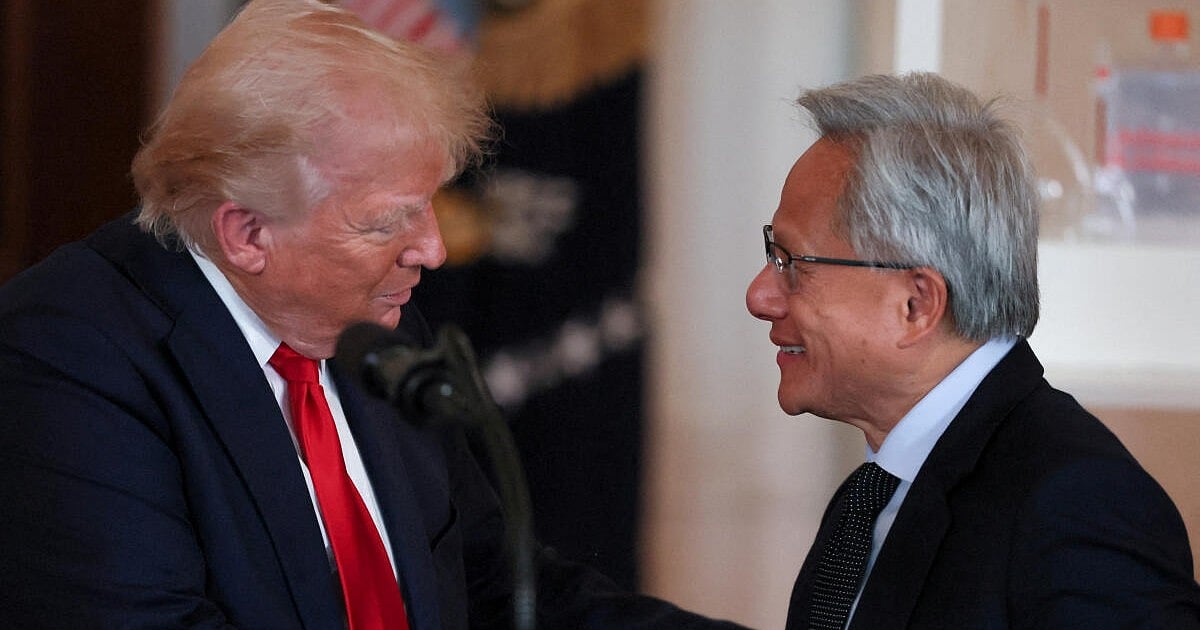
US President Donald Trump intervened to restore Jensen Huang as chief executive of Nvidia on Monday, eleven days after the chipmaker's board pushed him out amid a scandal involving alleged Chinese espionage. The move came after Trump publicly pressed for the reversal, and Nvidia's board accepted it. Huang's return has since become a flashpoint in Washington, where it is being read less as a corporate governance decision than as a test of how the administration weighs security warnings against market considerations.
Trump defended the decision in a CNBC interview on Monday, saying he had watched markets lose trillions of dollars in recent days, with the Huang affair a contributing factor, and that he felt compelled to act. He argued that without his involvement, Nvidia could have suffered for a long time. Nvidia shares recovered sharply after the announcement, adding close to $1 trillion in market value. Trump has said he holds Nvidia stock, a detail critics have seized on as a conflict of interest.
The intervention has run against the grain of the government's own intelligence assessments. US agencies have concluded that a businesswoman linked to Huang was engaged in espionage on behalf of China, and Trump has repeatedly dismissed those conclusions in public remarks. Critics say that stance leaves the administration open to the charge that national security considerations were set aside for the sake of a stock rally. Chip export controls, which were designed to restrict advanced semiconductor flows to China, are central to the concern.
The reaction has crossed party lines. Former House Speaker Newt Gingrich, a close Trump ally, publicly criticised the reinstatement, describing the relationship with the alleged Chinese agent as deeply troubling. Senator Jack Reed, a Democrat on the Senate Banking Committee, called for Congress to examine Trump's communications with Huang and the Nvidia board to establish what assurances, if any, were given. Huang is scheduled to testify before the committee on December 3, and that hearing is now expected to focus on the circumstances of his return as much as the espionage allegations.
The episode was compounded by Trump's own conduct. Shortly after Huang's reinstatement, the president shared an altered version of a widely circulated photograph taken after the 2024 assassination attempt at a rally in Butler, Pennsylvania, replacing his image with Huang's and adding offensive imagery. In remarks to The New York Times, Trump suggested that sex sold better than stocks, a comment that drew sharp criticism for trivialising both political violence and a serious espionage investigation.
The broader significance lies in what the case signals about decision-making at the top of the executive branch. Governance of strategic technology, from semiconductors to artificial intelligence, depends on predictable rules and the independence of security agencies from personal and commercial interests. If a president can override intelligence judgments to protect the value of a company in which he invests, the damage extends beyond one firm to the credibility of export controls and the trust allies place in American oversight. Whether Congress can establish the facts of the reinstatement will be an early test of that accountability.
For the full opinion analysis on which this report draws, see the original commentary.