In 30 Seconds
- Karnataka's Rajiv Gandhi University of Health Sciences will require non-state students, including those in medicine, to learn the local language from next year.
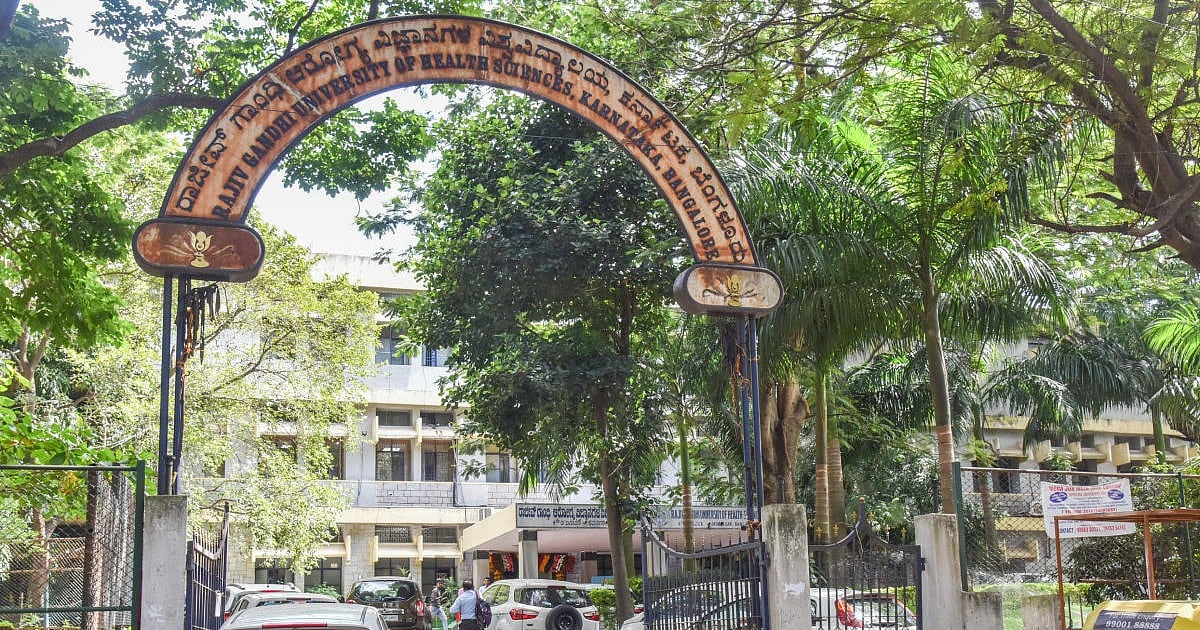
- The Rajiv Gandhi University of Health Sciences (RGUHS) in Bengaluru plans to make Kannada a required subject for students from other states admitted to its programmes, medicine included.
- This year, Kannada will be optional for the current batch, a way for the university to measure how many students want to learn it.
The Rajiv Gandhi University of Health Sciences (RGUHS) in Bengaluru plans to make Kannada a required subject for students from other states admitted to its programmes, medicine included. The rule will apply to current students too, but only in a softer form for now.
This year, Kannada will be optional for the current batch, a way for the university to measure how many students want to learn it. From next year, the language will be mandatory and carry a few credits.
The model is not untested. Kempegowda Institute of Medical Sciences (KIMS) in Bengaluru ran a pilot programme, and RGUHS Vice-Chancellor Dr Bhagavan BC said it has worked. According to KIMS figures, four batches have taken the classes so far. In a typical batch of 150, about 15 students come from other states, and 13 of them signed up and attended. Sources say roughly 40% of RGUHS students are from outside Karnataka, which makes the policy far from marginal.
Dr Bhagavan argued that patient care depends on communication. Doctors who can speak and understand the local language, he said, are better placed to talk with patients and to practise within the state. He also pointed to rising numbers of students taking NEET in Kannada each year, and said medicine, unlike engineering, is built on interaction, so the case for local-language skills is stronger.
Some experts want the university to go further. Homeopathic practitioner Dr BT Rudresh said Kannada should be compulsory with fixed credits, not optional, and that textbooks should be translated. The Visvesvaraya Technological University has required Kannada learning with credits since 2020, using separate materials for Kannadiga and non-Kannadiga students. Madhya Pradesh, for its part, has offered bilingual medical textbooks in English and Hindi.
The push has political backing. Chief Minister DK Shivakumar recently asked RGUHS to explore medical courses in the regional language. The university has sought an expert report on that idea, and Dr Bhagavan said it will go ahead, but it will need clearance from the National Medical Commission and the Nursing Council of India before any Kannada-medium teaching can start.
For students arriving from other states, the change means learning a new language alongside demanding clinical training. For the university, it is a test of whether language can be built into medical education without slowing it down. Full details are in the original report at Deccan Herald.